


Exploring how IEM’s 2004 exercise predicted real Hurricane Katrina scenarios
This month marks the 20th anniversary of Hurricane Katrina, a profound moment that reshaped U.S. disaster response and recovery. As we remember the lives affected and the communities rebuilt, we are reminded of the strength of the human spirit and lessons learned from our past.
One of the more prophetic Katrina-related moments came during IEM’s 2004 Hurricane Pam exercise, formally known as the Southeast Louisiana Hurricane Planning Project. IEM, with numerous federal and state agencies, created a catastrophic planning exercise predicting the impact of a major storm in Louisiana. The first-of-its-kind, functional, scenario-based exercise would later help guide preparedness and response efforts, eerily foreshadowing Katrina’s impact.
From Concept to Reality: How Hurricane Pam Took Shape
In 2004, IEM was awarded a Federal Emergency Management Agency (FEMA) contract to support catastrophic planning for Southeast Louisiana. As project architects, IEM and partners planned and held the workshop 53 days after the contract award. The eight-day exercise focused on six primary areas: Search and Rescue, Temporary Medical Care, Sheltering, Temporary Housing, Schools, and Debris.
IEM collaborated with the academic community to analyze behavioral research on hurricane responses and evacuations, plus empirical data on sheltering tendencies and other key factors. The team used this research with insights from local parish emergency managers to create a “worst-case but plausible” scenario for the Pam exercise.
“Hurricane Pam was designed to bring planners and decision-makers together from all levels so they could begin to grapple collectively with response issues for a catastrophic event and start the process of reviewing and reconciling their existing emergency plans,” said Madhu Beriwal, IEM Founder and Chairwoman, in a 2006 statement before the Senate Homeland Security and Governmental Affairs Committee.
The Hurricane Pam exercise featured 300 participants from 13 parishes, FEMA Headquarters and Regions I, II, IV, V, and VI, the Louisiana Office of Homeland Security and Emergency Preparedness (now the Governor’s Office of Homeland Security and Emergency Preparedness, or GOHSEP); over 20 state agencies; more than 15 federal agencies; the States of Mississippi and Arkansas, and numerous volunteer agencies.
The planning process was about “speed and integration,” says Brad Tiffee, IEM’s Chief Administrative Officer and former Hurricane Pam Project Manager. Bringing together stakeholders across all levels of government expedited the traditional planning process.
Hurricane Pam: Insights into the Simulated Storm
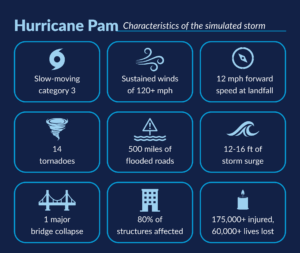 Hurricane Pam was a strong, slow-moving Category 3 hurricane that directly struck New Orleans and affected 13 parishes. At landfall, it had sustained 120 mph winds, created 20” of rain, and spawned 14 tornadoes. The storm caused levee failures and significant storm surge, leaving most of New Orleans under 10-20 feet of water.
IEM’s technical professionals predicted: 55,000 evacuees to shelters prior to landfall; a million displaced; 230,000 children out of school; 500 miles of flooded roadways; 12.5 million tons of debris and 250,000 cubic yards of hazardous household waste; significant infrastructure damage; 80% of structures with minor to major damage; $40 billion in damages; over 175,000 injured, more than 200,000 ill, and over 60,000 fatalities.
Through tabletop exercises and targeted discussions, the exercise produced drafts for 15 action plans.
Additional Exercises: Expanding Hurricane Pam
Three additional Hurricane Pam workshops were conducted before Hurricane Katrina struck:
- Hurricane Pam Phase 1A (November 29-December 3, 2004)—This first follow-up workshop, held in New Orleans, was attended by approximately 100 officials.
- Hurricane Pam Phase 1B (July 25-29, 2005)—The second exercise in New Orleans hosted approximately 100 officials.
- Temporary Medical Care Supplementary Planning Workshop (August 23-24, 2005)—The last exercise held days before Hurricane Katrina struck was in Carville, Louisiana, and approximately 80 officials attended.
Forecasting Reality: Key Predictions from Hurricane Pam
When Hurricane Katrina struck a year later, the Hurricane Pam scenario proved to be what has been called a “scientific bullseye.” Many simulated predictions happened in real life, and local officials applied Hurricane Pam knowledge to Katrina response and recovery efforts.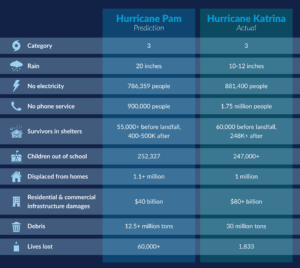
Shelter numbers closely matched Hurricane Pam predictions. Pre-landfall evacuations exceeded exercise expectations. Search and rescue operations confirmed planning assumptions, emphasizing the need for air and water rescue efforts.
Innovative concepts from the exercise proved effective in Katrina. ‘Lily pads’ enabled rescuers to bring victims to staging areas for transportation to temporary shelters, allowing faster rescues. Temporary Medical Operating Staging Areas (TMOSA), a concept introduced during Pam, became crucial to the Hurricane Katrina response.
One official estimated that almost 75% of Pam documentation was utilized during Katrina response. According to the U.S. Senate report Hurricane Katrina: A Nation Still Unprepared (May 2006), Hurricane Pam was a “unique planning endeavor that resulted in functional plans that were considered for and actually put to use in real-life situations before, during, and after Hurricane Katrina.”
This exercise was a significant step in reshaping emergency management and disaster response, showcasing the importance of planning and preparedness to strengthen response and recovery efforts.
Lessons Learned: Strengthening Capabilities
The Hurricane Pam exercise highlighted the critical need for preparedness and served as a reminder of a hurricane’s unpredictable nature and our capacity to respond. Key lessons continue to resonate in our ongoing efforts to enhance disaster preparedness, response, recovery, and resilience.
One key success was bringing together the right stakeholders in the planning process. This principle remains vital today. The exercise unified leaders from local and state government with FEMA and federal agencies to plan for catastrophic incidents.
However, many identified needs could not be addressed or funded by the time Katrina struck. The exercise and Katrina response underscored the need for a unified command with efficient coordination between local, state, and federal emergency management personnel.1
Pam also highlighted the need for inclusive mass evacuation planning. The exercise demonstrated the need for hospital evacuations, leading to the development of a post-landfall care and evacuation plan that was nearly complete when Katrina struck. Though not fully finalized, the planning was instrumental during the response and ultimately saved lives.2
To address challenges witnessed during Hurricane Katrina, Congress passed the Post-Katrina Emergency Reform Act (PKEMRA) of 2006. PKEMRA restructured FEMA and DHS, charging FEMA with singular responsibility for disaster response. The Act required better training through a vetted qualifications system and included the appointment of a FEMA Disability Coordinator to ensure consideration for functional and access needs during response and recovery.3
PKEMRA directed the FEMA Administrator to develop a National Disaster Recovery Strategy, promoting appropriate and cost-effective building materials to encourage disaster-resistant construction. It also required the development of a National Disaster Housing Strategy.
For 40 years, IEM has used data-driven decision-making and innovative planning to help communities prepare for, respond to, mitigate, and recover from disasters. We are here to assist states, tribes, territories, and local governments in solving complex problems through innovation and expert guidance. IEM’s experts engage key stakeholders in the planning process, engaging the whole community to ensure diverse needs are identified and addressed.
Connect with IEM’s experts today. Together, let’s build a resilient tomorrow.
————————————–
SOURCES
1, 2 https://biotech.law.lsu.edu/katrina/govdocs/109-377/pam.pdf
3 https://ncdp.columbia.edu/ncdp-perspectives/hurricane-katrina-19-years-later-with-policies/