

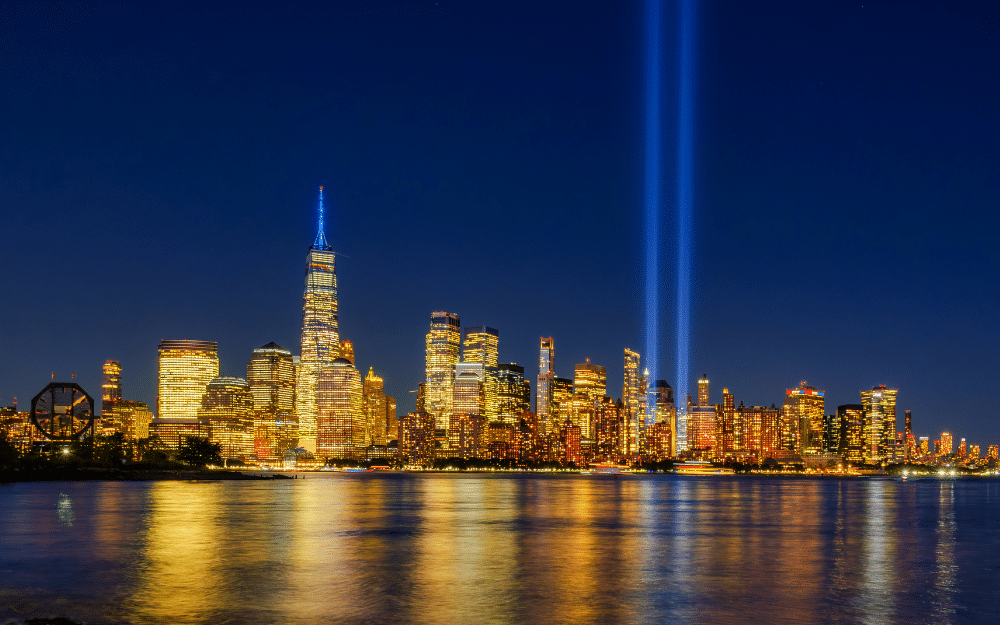
Twenty-five years after the attacks of September 11, 2001, the memories remain vivid: where people were, what they saw, who they called, and how the world seemed to change in a single morning. Nearly 3,000 lives were taken that day, including hundreds of first responders who ran toward danger to save others.
For those who work in emergency management and homeland security, September 11 is not only a moment in history. It is a reminder of why coordination, preparedness, communication, and public service matter before, during, and long after a crisis.
To mark this solemn anniversary, members of the IEM team shared their memories of that day and reflect on how 9/11 shaped their careers, their understanding of service, and the work they continue to do for communities nationwide.

President & CEO
What do you remember most from September 11, 2001?
“I was a Navy Lieutenant working at the President’s Emergency Operations Center at the White House and going to Business School at George Washington University in the evenings. I worked a 12-hour shift on 9/10 and went to class for six hours; I got home after midnight. 9/11 was an off day for me, so I was asleep when my wife Jennifer called me from her elementary classroom teaching job to tell me the news. I went downstairs and saw the smoke from the Pentagon, two miles from our house in Alexandria. My shipmates in the PEOC told me there was no way to get into the White House at the moment, so I spent the remainder of the day on our front steps with my neighbor trying to get her boss, the Secretary of Veterans Affairs, back from California. I rode my bike down the road to a hill overlooking the Pentagon and saw the devastation firsthand. I was back in the White House on 9/12, and I spent the next five years there reshaping continuity of government efforts and helping develop the homeland security effort as it exists today.”

Vice President, Disaster Recovery
What do you remember most from September 11, 2001?
“September 11th was a day I will never forget. I was a young lawyer working at HUD headquarters in Washington and could see the smoke plumes from the crash at the Pentagon across the river. Later, I learned a dear family friend had lost his life at Ground Zero.”
How did 9/11 influence your work in emergency management or homeland security?
“I was honored to have the opportunity to support the rebuilding in Lower Manhattan, when Congress provided HUD its first multi-billion-dollar CDBG-DR grant. I worked with the rebuilding team for 15 years, ensuring the expenditures of federal funds complied with rules and enabling waivers to achieve the community recovery goals.
The rebuilding of Lower Manhattan taught me the incredible value of calling on the community to form a collaborative vision for recovery. New Yorkers and people from all over the country and the world shared ideas for rebuilding. Twenty-five years later it is so much more than it was right after the attacks; there is a memorial and museum honoring the lives lost and the heroes who saved many more. It is a thriving neighborhood that lives on.”

Director, Recovery
What do you remember most from September 11, 2001?
“The thing I remember the most about 9/11 is the silence with the skies, without any aircraft, with people and the way that we were processing what had happened. There was a silence across the nation and a silence in my community. And that silence helped us grieve. That silence helped us be thoughtful about how we were going to function after 9/11 and our recovery. But that silence was deafening for quite some time and that has helped drive many of us in the work that we do, and how we do it for how we remember that event specifically, that was a watershed event in our industry. And that silence drives me today to never forget and ensure that we do all that we can do to prepare our communities to prevent these types of activities from occurring, to be able to respond to them and recover from them, while mitigating where at all possible.”

Chief Communications Director
What do you remember most from September 11, 2001?
“On that cloudless, blue-sky day, I had just pulled up to the garage when I heard the news of the first plane hitting the World Trade Center. At the time, I was working at a Arlington (VA) think tank, with a terrorism center that had recently published books on bin Laden. We watched the second plane hit the Towers on our conference room TV, then later I saw the smoke from the Pentagon. A friend working at the Pentagon literally ran from a fireball with her colleagues. Thankfully, she survived. The next several days were a blur of media interviews, since our bin Laden research had suddenly become urgently relevant.”
How did 9/11 influence your work in emergency management or homeland security?
“At the time, I was at a think tank that had just published a book on bin Laden. That work suddenly became the center of the national conversation. That tragic day was also responsible for ultimately launching my career into homeland security, first at DHS’s Science & Technology Directorate, later in the Secretary’s Office of Intergovernmental Affairs. 9/11 isn’t distant history to me; it’s the reason I do this work. I was honored to be an early employee of DHS and to work with those who aim to keep our nation safe.”
How does working in this field give you a different relationship to the history of 9/11?
“9/11 showed me firsthand how fast an ordinary morning can become a national crisis, and how much clear communication matters in that moment. It set me on a path through DHS and FEMA before I came to IEM. Back then, the mission centered on intelligence sharing and delivering real-time information to state and local responders, the true boots on the ground. That same federal-to-local partnership remains the heartbeat of homeland security.”

Howard Stronach
Senior Advisor, Recovery
How did 9/11 influence your work in emergency management or homeland security? What’s changed most about the field since then?
“Following 9/11, I worked on several Public Assistance issues related to New York City’s recovery, including aspects of the World Trade Center debris operation. One of the most meaningful experiences of my career was working with Richard Marx, the FBI’s lead official for evidence recovery at the site. Together, we helped develop protocols that integrated crime scene management and evidence collection requirements into debris management operations, an unprecedented challenge at the time. I was honored when he agreed to share those lessons as an instructor in FEMA’s Debris Management course at EMI. Through that experience, I truly realized how important coordination, communication, and good relationships are to success in emergency management.
From a broader perspective, 9/11 fundamentally changed the field of emergency management. Before the attacks, terrorism was not a primary focus for most emergency managers. In the years that followed, FEMA became part of the newly established Department of Homeland Security, coordination with law enforcement and intelligence agencies expanded significantly, and national planning doctrine evolved to address terrorist threats alongside natural disasters. The Federal Response Plan was replaced by the National Response Plan, reflecting a more integrated approach to preparedness and response.
Perhaps the most significant change was the recognition that emergency management must be prepared for all hazards including terrorism. The lessons of 9/11 reshaped policies, planning, training, and partnerships at every level of government and continue to influence the profession today.”
How does working in this field give you a different relationship to the history of 9/11?
“Toward the end of the World Trade Center debris operation, I attended a hotwash with New York fire, police, and public works officials to discuss how communities could better prepare for a future catastrophe of similar scale. During those discussions, I witnessed firsthand the grief carried by responders who had lost friends, family members, and colleagues. I will never forget listening to firefighters describe digging through the rubble with their bare hands in search of survivors and fellow responders. The pain on their faces and in their voices was difficult to witness, but it created a connection to their experience that I didn’t have prior to that moment.
Working in emergency management has given me a profound appreciation for the courage, sacrifice, and resilience of first responders and public servants. The experience reinforced for me that emergency management is ultimately about people, communities, and helping others during their darkest moments. The lessons and memories from 9/11 continue to shape how I view public service and the responsibility that comes with it.”

Mandy Gardner
Manager, Planning & Preparedness
If you joined the field after 9/11, how did learning about or experiencing the attacks shape your decision to work in the field?
“As a high school student, I watched the second plane hit the World Trade Center on live TV with my English class. Like many Americans, 9/11 shaped how I saw the world and led to my decision a few years later to join the first graduating class of The Ohio State University’s International Studies – Security & Intelligence major, a brand new program created in response to 9/11.
Today, I work in emergency management and homeland security, helping communities across the United States prepare for disasters and incidents of all types, including the kinds of threats that first drew me to this profession.”
The stories shared here span different generations, career paths, and points of view, but they are connected by a common thread: a deep respect for the lives lost, the responders who served, and the responsibility that followed. September 11 reshaped the fields of homeland security and emergency management, strengthening the focus on preparedness, coordination, communication, and resilience across every level of government.
Twenty-five years later, remembrance is still part of the work. It lives in the commitment to help communities we serve.
We share these stories today not only to remember what was lost, but to honor the response, the resilience, and the commitment to service that followed. That commitment is what continues to guide IEM’s work: in communities prepared before crises strike, responding when help is needed, recovering with care, and carrying forward the lessons learned from one of the most defining days in our nation’s history.
We will never forget.